How to Accept Crypto Payments for Your Business To accept crypto payments, you need three things: a wallet to receive the funds, a way to show customers what to pay, and a reliable way to confirm the right amount arrived. Everything else is a choice about convenience.
The three parts of any crypto payment setup
1. A wallet that you control. This is where the money lands. If you hold the keys, the funds are yours the moment the transaction confirms. If a third party holds them, you're trusting that third party to pass them on.
2. A payment request. Customers need to know what to pay, how much, and where to send it. This can be as rough as a wallet address pasted into a chat, or as polished as a checkout page.
3. Confirmation. You need to know that the payment actually arrived, that it was the right amount, and that it came in the right currency. Blockchains are public, so this is checkable, but someone (or something) has to do the checking.
Which crypto should you accept?
Start with fewer options, not more.
Stablecoins like USDC are designed to track the US dollar, so a $200 invoice stays about $200 between sending and receiving. Native coins like SOL can change in value quickly. That's fine if you're happy to hold or convert them, but it complicates pricing.
For most businesses, a stablecoin is the simpler starting point because your prices stay predictable.
Three ways to accept crypto Approach Effort Main drawback Send your wallet address manually Almost none Easy to make mistakes, no clear record, you verify everything yourself Build your own checkout High Development time and ongoing maintenance Use a payment link Low Less customization than a fully custom checkout
Sharing a wallet address works for a one-off payment from someone you know. It breaks down quickly when you have several customers, because you end up matching incoming transactions to invoices by hand.
Building a checkout gives you control, but you take on the engineering and the responsibility for getting verification right.
A payment link sits in the middle: you create a request, send it, and the customer pays from it.
Mistakes to avoid Wrong network. A wallet address is only valid on the network it belongs to. Tell customers exactly which network you expect. Wrong amount. If you quote in dollars but accept a volatile coin, the amount received can differ from what you intended. No paper trail. Keep a record of what each payment was for. Your accountant will want it. Weak wallet security. If you control the keys, you're also responsible for protecting them.
Tax and legal treatment of crypto payments varies by country. This guide is general information, not professional advice, so check the rules where you operate.
Where depaylink fits
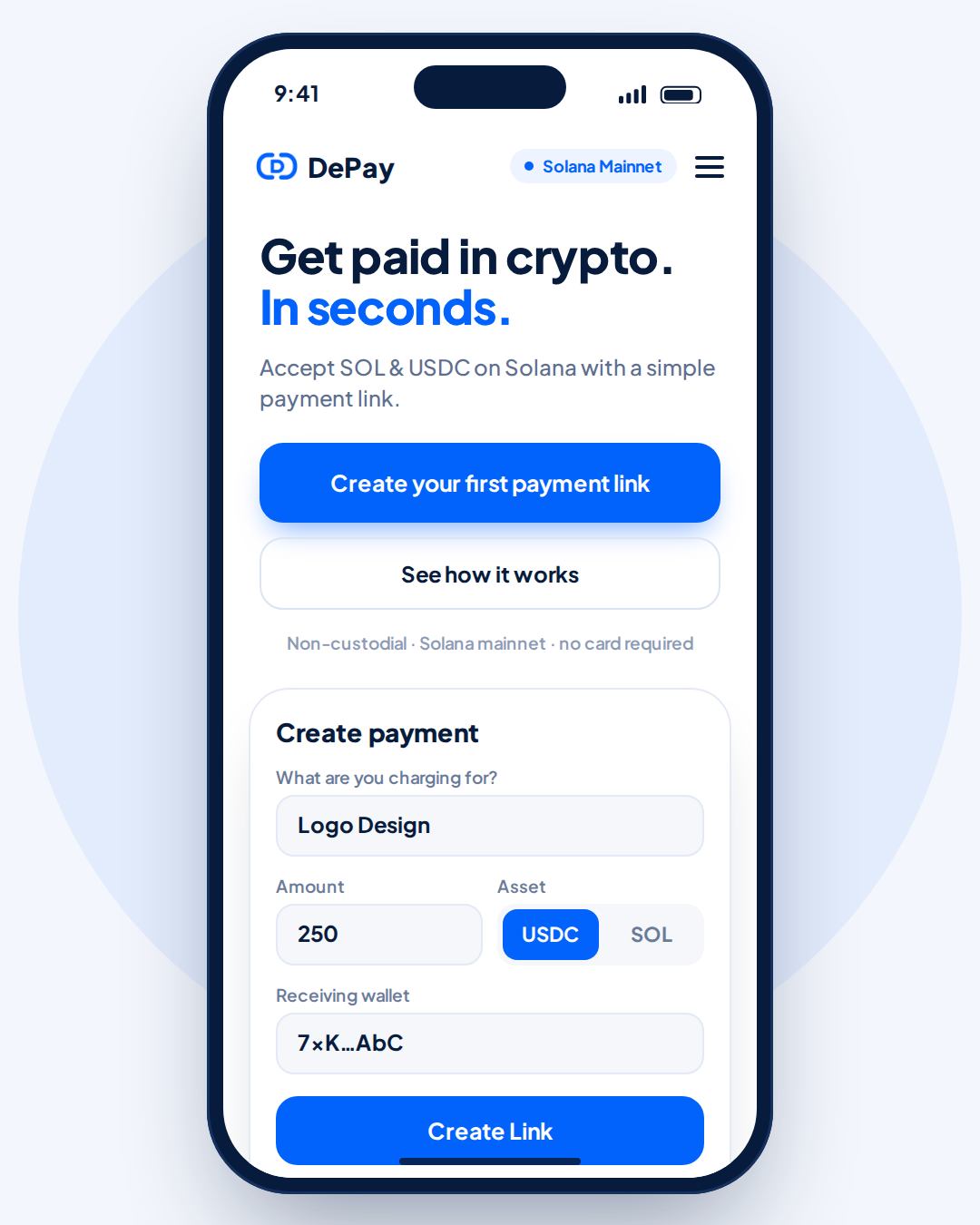
depaylink is a non-custodial payment-link product built for Solana. You create a payment link, share it with your customer, and they pay in SOL or USDC on Solana. The payment goes directly to your own wallet, and depaylink verifies it on-chain. You don't have to build a crypto checkout yourself.
A sensible first setup Set up a wallet you control and back it up securely. Decide whether you'll accept USDC, SOL, or both. Create a payment link for your first request. Send it to a friendly customer first and check the whole flow. Record what each payment was for. FAQ
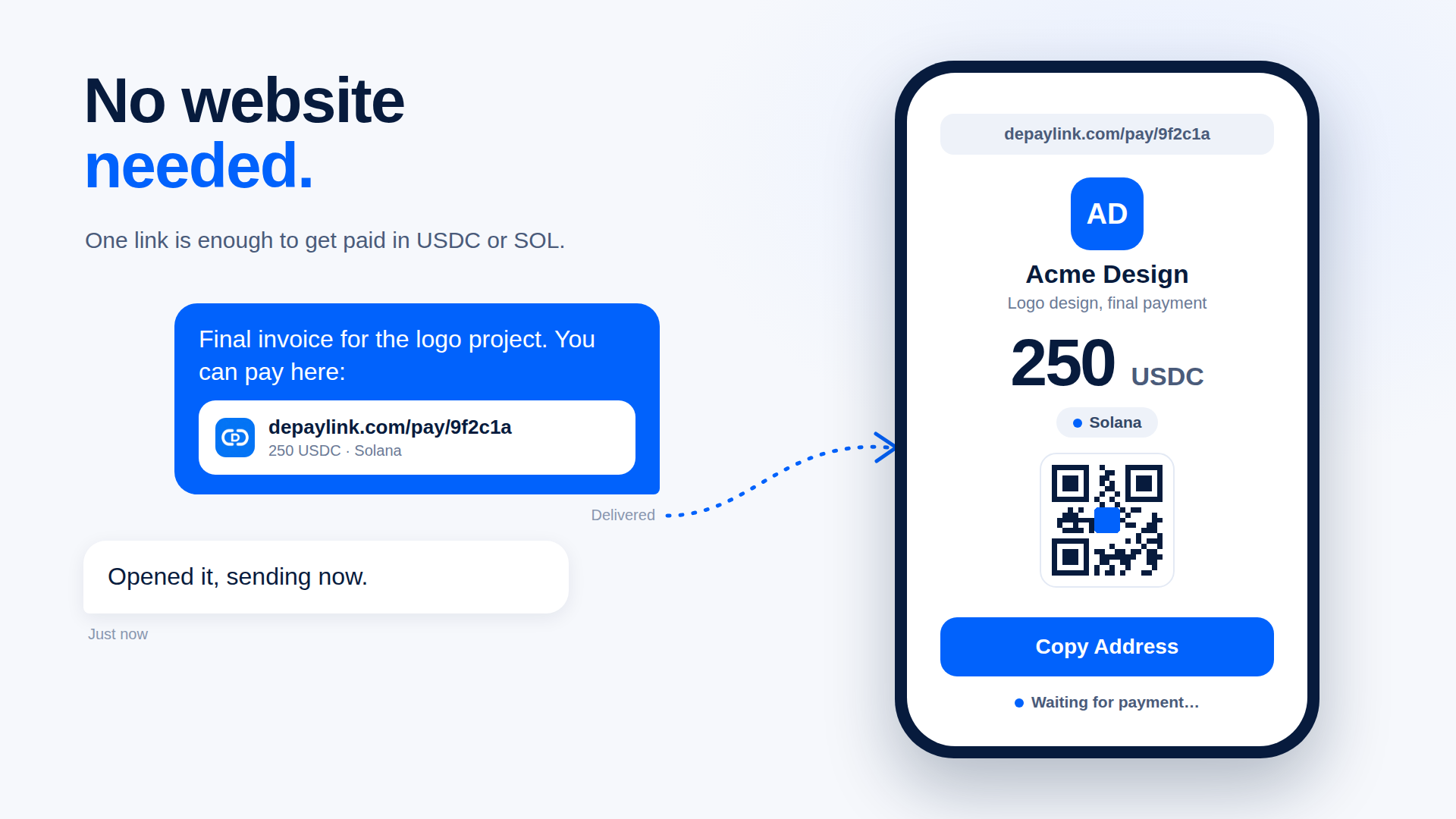
Do I need a website to accept crypto? No. A payment link can be shared in an email, a message, or on social media.
Do customers need to be crypto experts? They need a wallet and the right currency, but the payment itself is a few taps.
Can I accept crypto and still use bank payments? Yes. Crypto can be one option alongside others.
Who holds the money? With a non-custodial setup, you do. The payment goes to your own wallet.How Freelancers Can Get Paid in USDC (Without Chasing Invoices Across Borders)How to Get Paid in USDC as a FreelancerHow to Accept Crypto Payments Without a WebsiteWhat Is a Crypto Payment Link? (And How It Works)How to Accept USDC Payments (and What to Check First)How to Accept Crypto Payments Online: 3 Ways to Do It