**How to Accept Crypto Payments Without a Website
You can accept crypto payments without a website using three things*: a wallet that can receive the coin, a way to tell the payer exactly how much to send and where, and a way* to confirm the money arrived. A website is just one way to deliver the second thing. A link, a QR code or even a message can do the same job.
The catch is that some methods do it much more safely than others. Sending a bare wallet address in a chat works, until the client sends the wrong token, uses the wrong network, or asks "did it go through?" and you have no clean answer.
This guide covers the realistic options, where each one fails, and how to set up a flow that looks professional without building anything.
What you actually need to get paid
Strip away the checkout pages and plugins, and every crypto payment needs the same three pieces:
A receiving address. A wallet you control, on the network your payer will use. A clear payment request. The amount, the currency (SOL or USDC, for example), the network, and what the payment is for. Confirmation. Proof, visible on-chain, that the right amount arrived at the right address.
A website bundles all three. Without one, you have to cover them some other way. Most mistakes happen when people cover the first piece and skip the other two.
Five ways to accept crypto without a website
Method Setup time Works well for Where it breaks
Send your wallet address Seconds Friends, one-off transfers between people you trust No amount, no currency, no network check, no receipt
Share a QR code of your address Minutes In-person payments, event tables Same gaps as a bare address, and the amount is still manual
Wallet payment request feature Minutes Payers using the same wallet app Depends on the payer's wallet supporting it Invoice with your address pasted in 10–20 minutes Clients who expect a formal document Address copied by hand, amount not enforced, confirmation is manual
Payment link Minutes Clients, customers, anyone who needs a clear request Needs a service that generates the link
None of these is wrong. They differ in how much risk you leave to the payer's memory and attention.
Why a bare wallet address isn't enough
The "just send me your address" approach fails in predictable ways:
Wrong network. Many wallets and exchanges support several networks. Funds sent on a network your address doesn't use can be hard or impossible to recover. Wrong token. A payer sends SOL when you quoted in USDC, or the other way around, and now the amount you receive depends on the market rather than your invoice. Wrong amount. Nothing stops someone from sending 240 when the invoice says 250. No context. Six months later, a transfer in your wallet history says nothing about which client or project it belonged to. Typos. Wallet addresses are long. Copying one by hand into an invoice or typing it from a screenshot invites mistakes.
If you do use a bare address, send a small test transaction first, state the network and token in words next to the address, and write the amount explicitly.
How a payment link solves the missing pieces
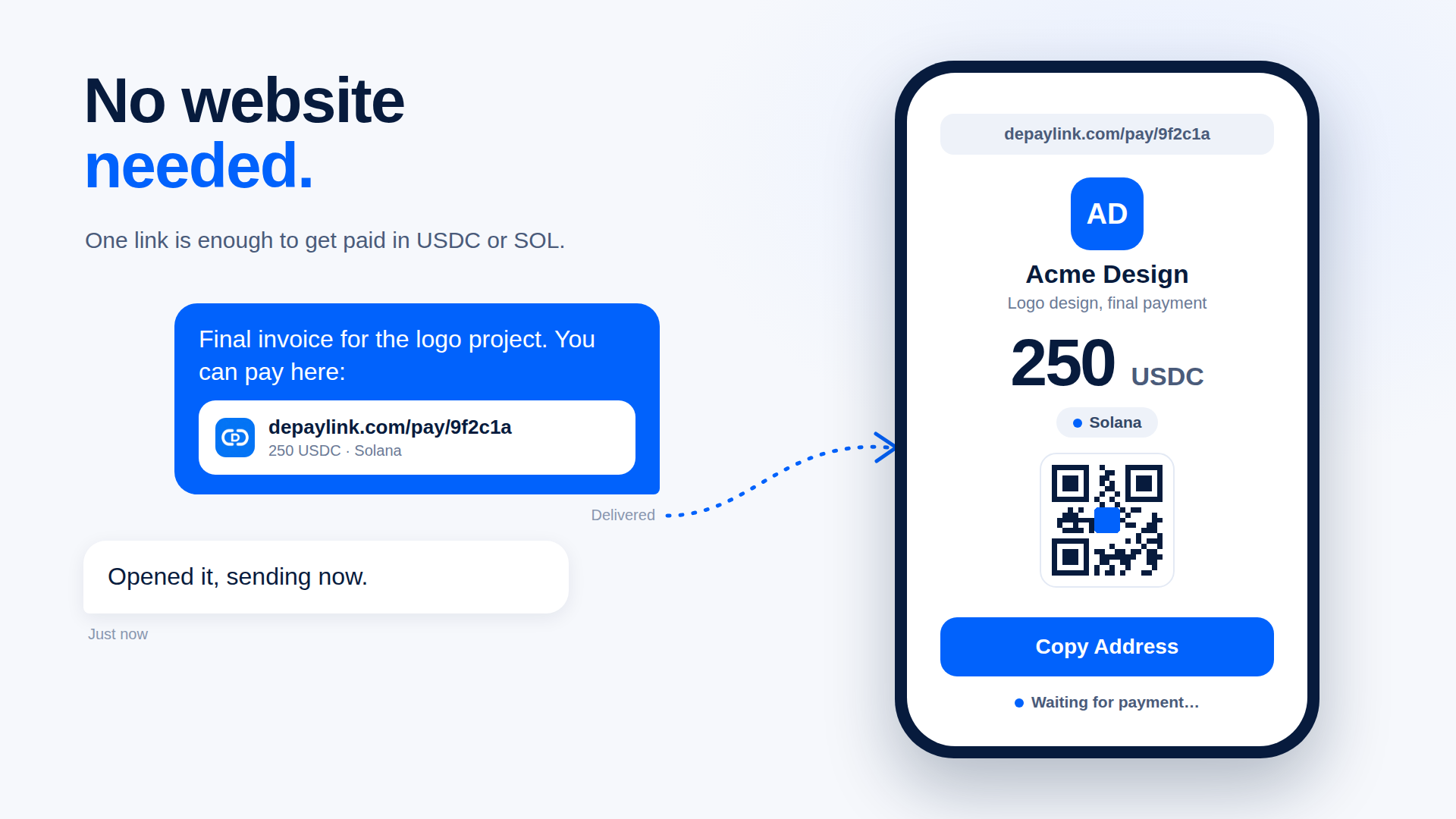
A payment link is a URL that opens a page showing everything the payer needs: the amount, the token, the network and the destination. The payer doesn't have to interpret anything. They follow the page.
That covers the second piece (a clear request) and makes the third easier, because the page can show whether a payment has been detected instead of leaving you to check a block explorer by hand.
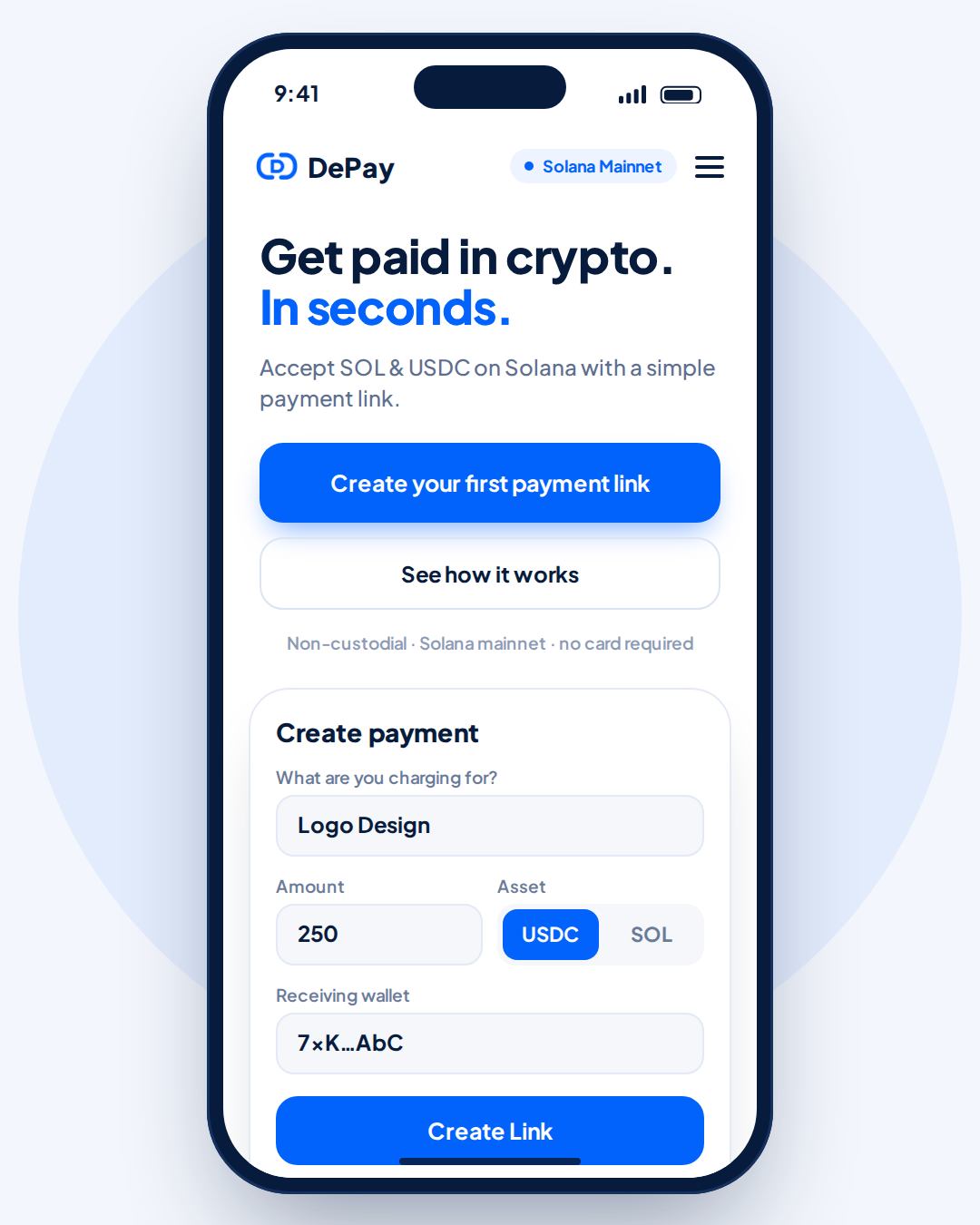
*Here is how it works with a depaylink payment link, which supports SOL and USDC on Solana: * Create the link. Enter the amount, choose SOL or USDC, and add a short description such as "Logo design, final payment." Share it anywhere. Send it in an email, a DM, an invoice PDF or a message. You can also share the link's QR code. The payer opens the page. They see the amount, the network and the receiving address, and send the payment from their own wallet. The page shows the status. It waits for the payment and updates once the transaction is detected on-chain. The funds go to your wallet. The payment is sent to the wallet address you set up, rather than being held by the link service first.
You don't build a checkout, install a plugin or host anything. Each link is a request you can tie to a specific client or project, which also gives you a clean record later.
SOL or USDC: which should you ask for?
If you price your work in dollars, USDC is usually the simpler request. It is a stablecoin designed to track the US dollar, so the amount you invoice is the amount you expect to receive. SOL can be a good fit if you want to hold it or your clients prefer paying in it, but its price moves, so decide in advance how the amount is calculated.
A practical approach for services: Fixed-price projects: quote in USDC. Clients who insist on SOL: convert the dollar price at the moment you send the link, and state the amount in SOL clearly in the request. Retainers: pick one currency per contract, so you aren't renegotiating every month.
Stablecoins carry their own considerations, including issuer and regulatory risk, so it's reasonable to decide how long you want to hold the balance.
Seven habits that prevent most payment problems
Match the network. Tell the payer which network to use, in plain words, every time. Put the amount in the request, not in a separate message that can get lost. Use one link per payment. It keeps your records clean and avoids "which invoice was this for?" later. Test with a small amount the first time you work with a new wallet or a new client. Confirm before delivering. Wait until the payment shows as received on-chain before you hand over files or access. Keep your own record. Save the link, the transaction reference and the date alongside the invoice or project file. Secure your receiving wallet. Protect your recovery phrase offline and never share it with anyone, including anyone claiming to offer "support."
A quick note on taxes and rules
Whether crypto income is taxable, how it must be reported, and whether you need to invoice in a particular way depends on where you live and how you operate. This article is general information, not tax or legal advice. A local accountant who understands digital assets can tell you what applies to you.
When this approach stops being enough
Going without a website works well for freelancers, creators and small teams that take payments one conversation at a time. If you start selling products to strangers, need inventory, shipping or automated delivery, you will probably want a proper storefront at some point. Even then, many people keep payment links for invoices, deposits and custom work.
FAQ
Can I accept crypto payments with no website and no coding? Yes. A wallet and a way to share a payment request (a link, a QR code, or an address with clear instructions) is enough. A payment link tool removes the manual parts without any development.
Do I need to register a business to accept crypto? Not as a technical requirement. Whether you need to register for tax, licensing or reporting purposes depends on your country and activity, so check with a local professional.
What happens if a client sends the wrong token or uses the wrong network? Recovery depends on the specifics and is sometimes impossible. This is the main reason to state the network and token clearly and to ask for a small test payment with a new client.
How do I know the payment arrived? Check that the transaction is confirmed on-chain and that the amount and token match your request. A payment link page that shows payment status makes this easier than checking manually.
Can I accept payments from clients who have never used crypto? They will need a wallet and some SOL or USDC first. If your client is new to crypto, tell them up front, or offer another payment method alongside it.How to Create a Crypto Payment Link (Step by Step)