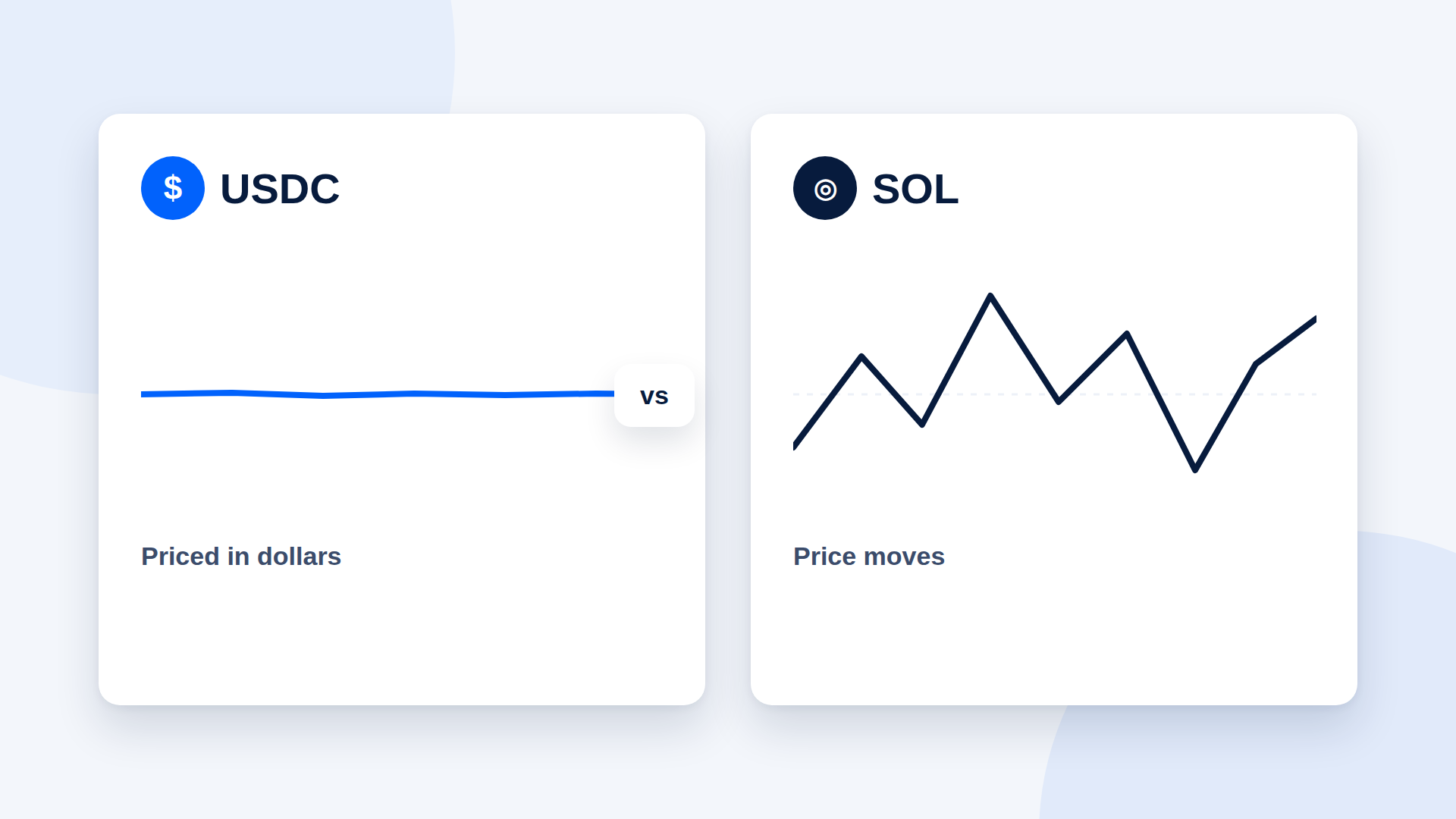
For most payments priced in a fiat currency, USDC is the simpler asset to accept, because it is designed to stay at one dollar. SOL is Solana's native token, and its price moves, so the amount you receive can be worth quite different amounts from one day to the next. SOL makes sense when your customer already holds it and you are happy to carry the price movement.
What each one is
USDC is a stablecoin issued by a company called Circle, designed to be redeemable for one US dollar. On Solana it is a token that lives in your wallet.
SOL is the native token of the Solana network. It pays network fees and trades freely, so its price changes with the market.
Side by side
| USDC on Solana | SOL | |
|---|---|---|
| What it is | Dollar-pegged stablecoin | Network's native token |
| Price vs USD | Designed to stay near $1 | Moves with the market |
| Good for | Invoices and prices in dollars | Customers who hold SOL; people who want SOL exposure |
| Accounting | Amount maps simply to USD value | Value must be recorded at time of receipt |
| Main risks | Peg, issuer, regulatory | Price volatility |
| Pays network fees? | No; fees are paid in SOL | Yes |
| Needs a wallet | Yes | Yes |
Price stability
If your invoice says 250 USD, 250 USDC covers it. If you ask for SOL, someone has to convert 250 USD into SOL at a chosen rate, and the value can change between invoice and payment. Fixing the rate at the time of invoice and giving a short validity window reduces disputes.
Fees
Network fees on Solana are paid by the sender in SOL. That means a customer paying you in USDC still needs a little SOL in their wallet. Fee levels are set by the network, not by the asset being sent.
Accounting and tax
Both need records. With USDC the dollar value is usually straightforward; with SOL you record the value at the time you received it, and later movements may create further reporting questions. Rules depend on where you live, so ask a local accountant.
Risk
USDC's main risk is that its dollar value could slip, or that rules around the issuer could change. SOL's main risk is that its price falls or rises sharply while you hold it. Neither is risk-free.
When to choose which
- Choose USDC if you price in dollars, send invoices, or want predictable income.
- Choose SOL if your customers prefer it, you want exposure to SOL, or you are comfortable converting right away.
- Accept both if you want flexibility, but create a separate request for each asset so the amount is never ambiguous.
A practical middle path
Many merchants list prices in USDC and accept SOL only on request, using a rate agreed at the time of the invoice. Others accept SOL and convert immediately to avoid carrying price risk.
Where DePayLink fits
DePayLink supports both SOL and USDC on Solana. When you create a payment link you choose the asset, so the payer sees one clear amount and asset. DePayLink verifies amount, asset and destination on-chain before marking the payment as paid, which helps catch a payment sent in the wrong token.
Frequently asked questions
Can customers pay in SOL even if I priced in USDC?
Only if you agree on a conversion rate and create a request in SOL. Otherwise ask for USDC.
Do I need SOL to receive USDC?
You do not need it to receive. You need a little to send transactions, for example to pay refunds.
Which is cheaper to send?
The network fee is in SOL for both. The asset you send does not change the fee.
Is USDC always worth exactly one dollar?
It is designed to be. Its market price can vary slightly and has briefly dropped below one dollar in the past.