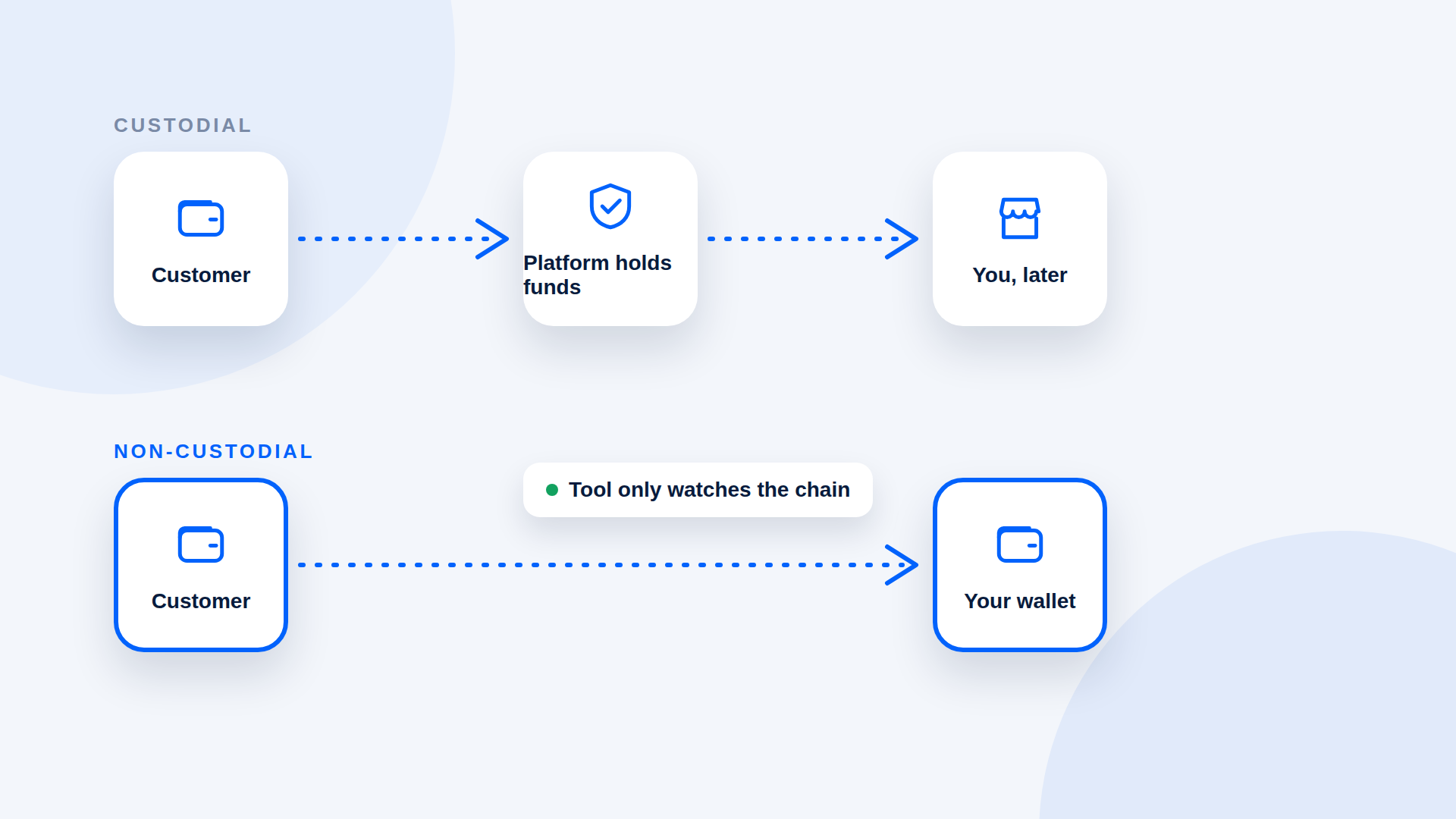
A custodial crypto payment processor receives your customer's payment first and pays you out later. A non-custodial tool never holds the money: the customer pays straight to your wallet, and the tool only watches the blockchain to confirm the payment. The difference decides who controls your funds in between, and that matters more than most feature lists.
How each model works
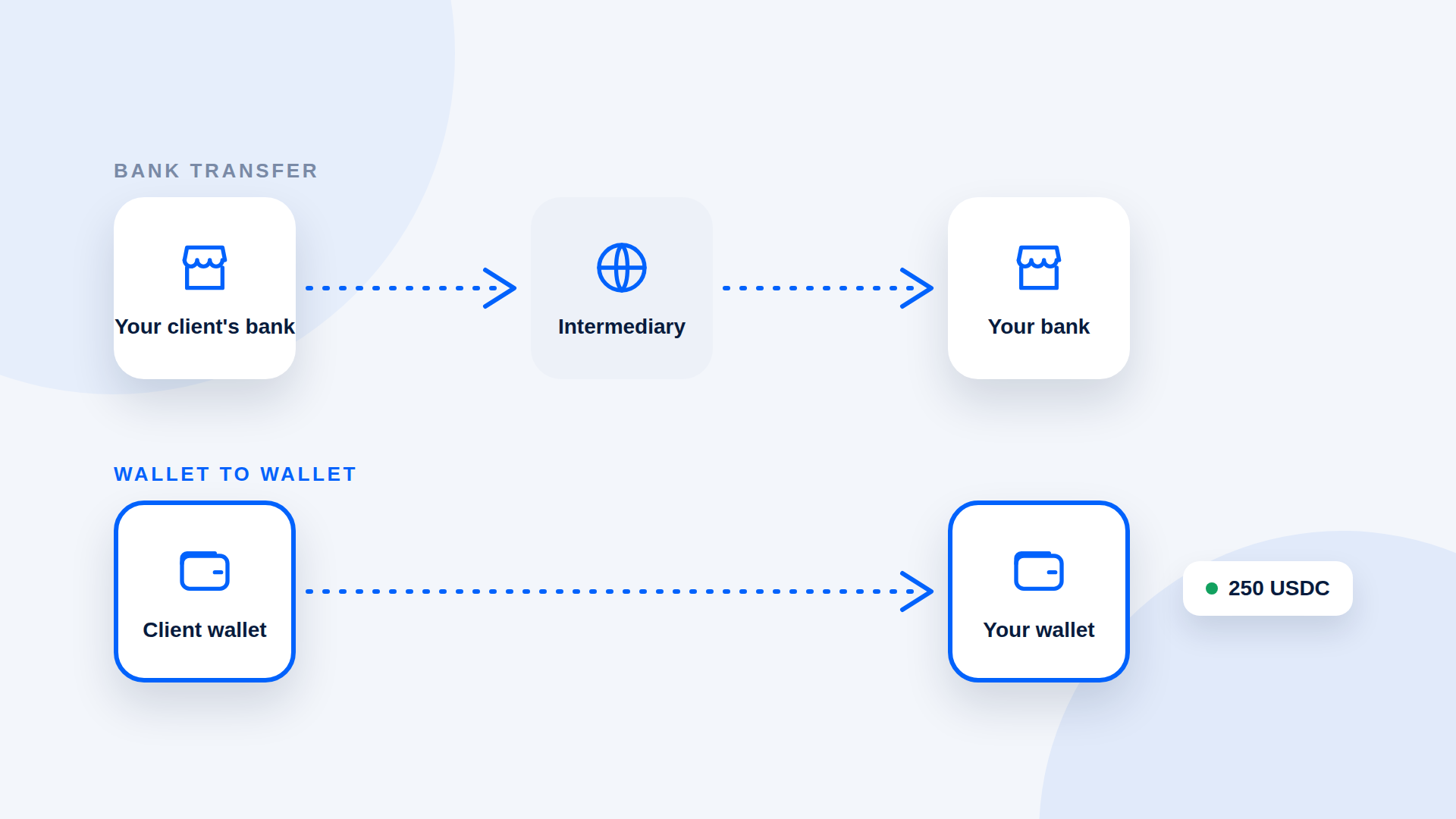
Custodial: The customer pays into the processor's wallet or account. The processor records the payment, keeps a balance for you, and pays out on its schedule, sometimes converting to local currency along the way.
Non-custodial: The customer pays into your wallet. The tool generates the payment request and monitors the blockchain, then marks the payment as paid once amount, asset and destination match.
Side by side
| Custodial | Non-custodial | |
|---|---|---|
| Who holds funds in transit | The processor | Nobody; funds go to your wallet |
| Payout delay | Depends on the provider | None; you receive directly |
| Wallet needed | Often not | Yes |
| Fiat conversion | Often built in | Separate step |
| Counterparty risk | You depend on the provider | You depend on your own wallet security |
| Verification to start | Often KYC/KYB | Varies; some need none |
| Refunds | Provider-managed in some cases | You send a new payment |
| Responsibility for key security | Provider | You |
When custodial makes sense
- You want payouts in local currency without managing a wallet.
- Your finance team requires a provider-managed balance and reports.
- You prefer someone else to handle security and have accepted the trade-offs.
When non-custodial makes sense
- You want funds in your own wallet the moment the customer pays.
- You want to avoid onboarding checks and payout delays.
- You are comfortable keeping your own recovery phrase safe.
- You work with crypto-native customers who already hold USDC.
Risks on both sides
Custodial risks: delays, account reviews or freezes, provider insolvency, and dependence on the provider's policies.
Non-custodial risks: lost or leaked recovery phrases, mistaken addresses, and no provider to help recover funds. You are your own security team.
Questions to ask any provider
- At what moment do I receive control of the funds?
- Can the provider freeze or delay my money?
- What verification do I have to complete?
- What happens to my funds and data if the provider shuts down?
- How is each payment verified?
Compliance still applies
Non-custodial does not mean obligation-free. You remain responsible for tax, reporting and local rules. Ask a local professional.
Where depaylink fits
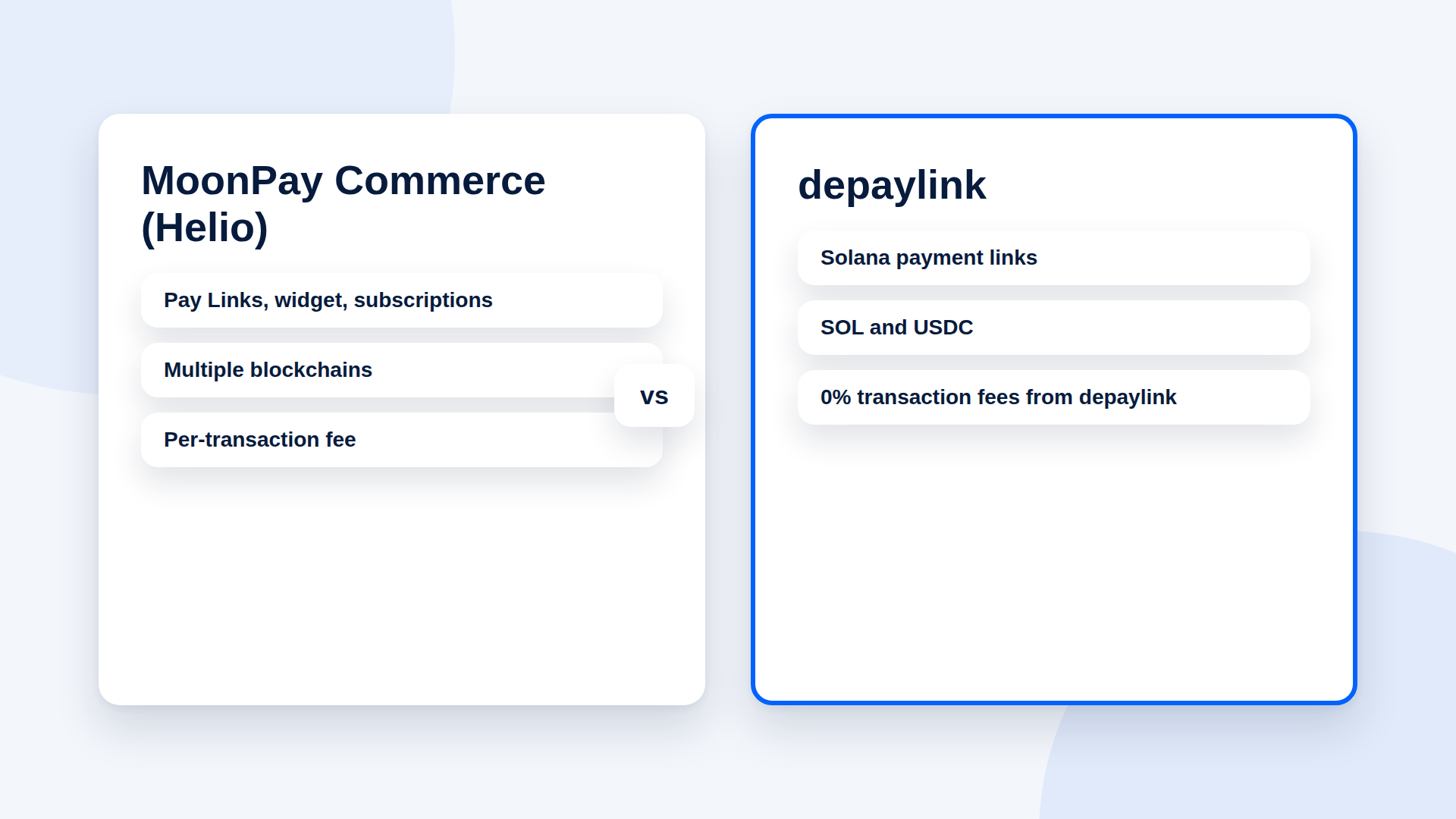
depaylink is non-custodial. Customers send SOL or USDC directly to the wallet address you enter, and depaylink only watches Solana and marks the payment as paid after checking amount, asset and destination. It does not convert to local currency; cashing out is a separate step through whichever service you choose.
Frequently asked questions
Is non-custodial safer?
It removes counterparty risk from a provider but shifts security to you. Neither is risk-free.
Can a non-custodial tool freeze my funds?
It cannot, because it never holds them. Funds are in your wallet.
Do I need a wallet for custodial processors?
Often not, because the processor can pay out to your bank. Check the details.
Can I switch between models?
Yes, because your customers pay a link or address, not an account. Plan how you will handle open payments during a switch.
Related reading
- Non-custodial payments
- How to Choose a Crypto Payment Gateway: A Buyer's Checklist
- How to Set Up a Solana Wallet to Receive Payments
- Crypto Payment Processing Fees: What You Actually Pay
- Best Way to Accept Crypto Payments Online: 5 Options Compared
- How to Verify a Crypto Payment Before You Deliver
- Crypto Payment Gateway vs Payment Link: Which Do You Need?