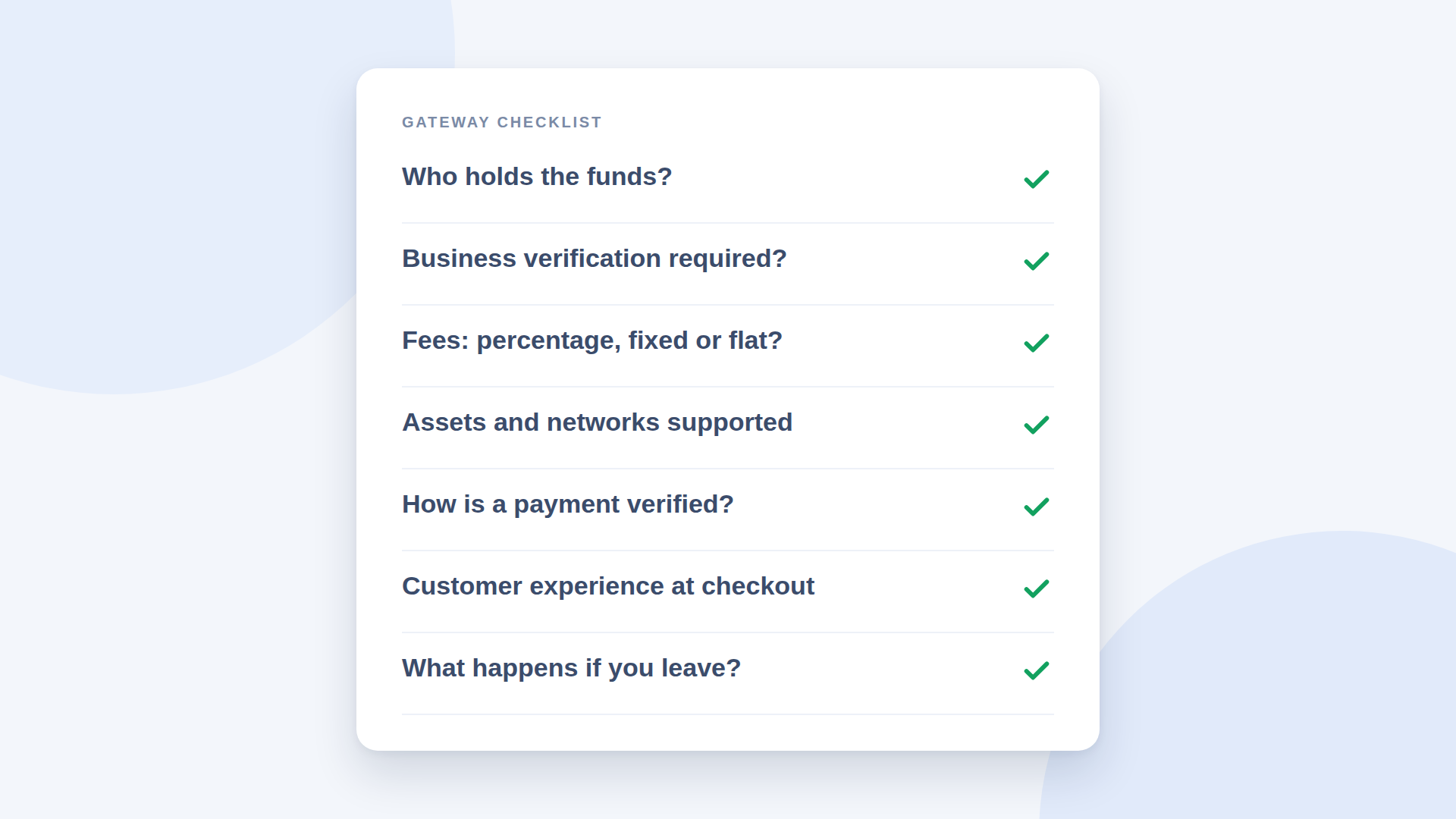
Choose a crypto payment gateway by asking seven questions: who holds the funds, what verification you must complete, how fees work, which assets and networks it supports, how payments are verified, what your customers experience, and what happens if you leave. The answers matter more than any feature list.
1. Who holds the funds?
Some gateways receive the customer's payment and pay you later. That is custodial: they hold the money for a time. Others let customers pay directly to your wallet and only observe the blockchain. Neither is automatically wrong, but you should know which you are buying, because custody affects delays, freezes and counterparty risk.
2. What verification do you have to complete?
Some providers require identity or business verification (often called KYC or KYB) before you can take payments. Others let you start without it. This affects how fast you can begin and which privacy trade-offs you accept. Whatever the provider requires, you remain responsible for your own tax and compliance obligations.
3. How are fees structured?
Look for the full picture:
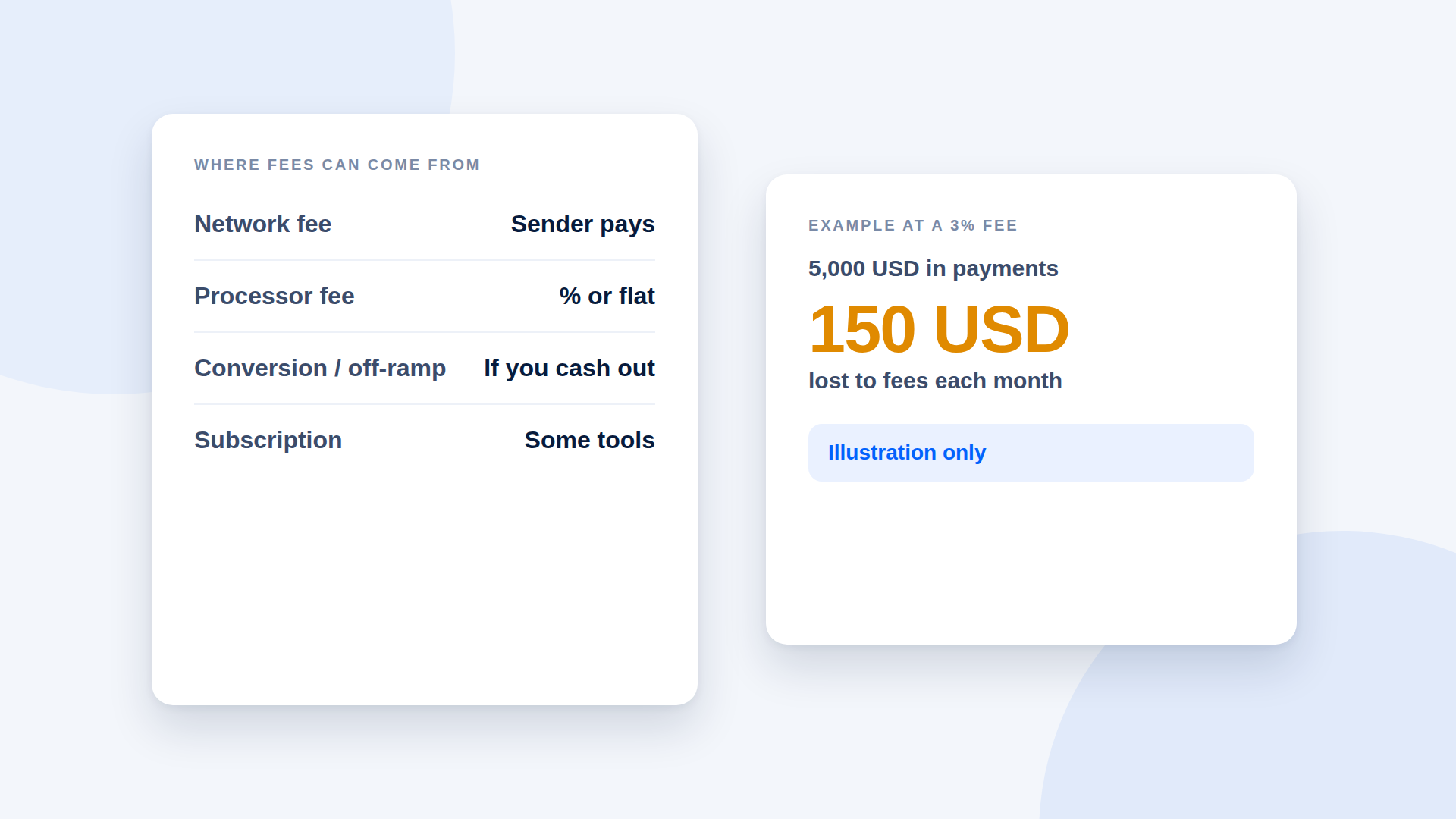
- A percentage of each payment, a flat fee, or a subscription
- Network fees for each transfer (usually paid by the sender)
- Conversion or withdrawal fees if you cash out
- Fees for extras such as branding or analytics
Compare using your own numbers: estimate your monthly volume and calculate what each structure would cost.
4. Which assets and networks does it support?
Make sure the gateway supports what your customers actually hold. A gateway that offers many assets is not better if your customers all use one stablecoin on one network.
5. How is a payment verified?
You want amount, asset and destination checked automatically before a payment is marked as paid. Ask what happens with underpayments, wrong tokens and late payments.
6. What does the customer experience?
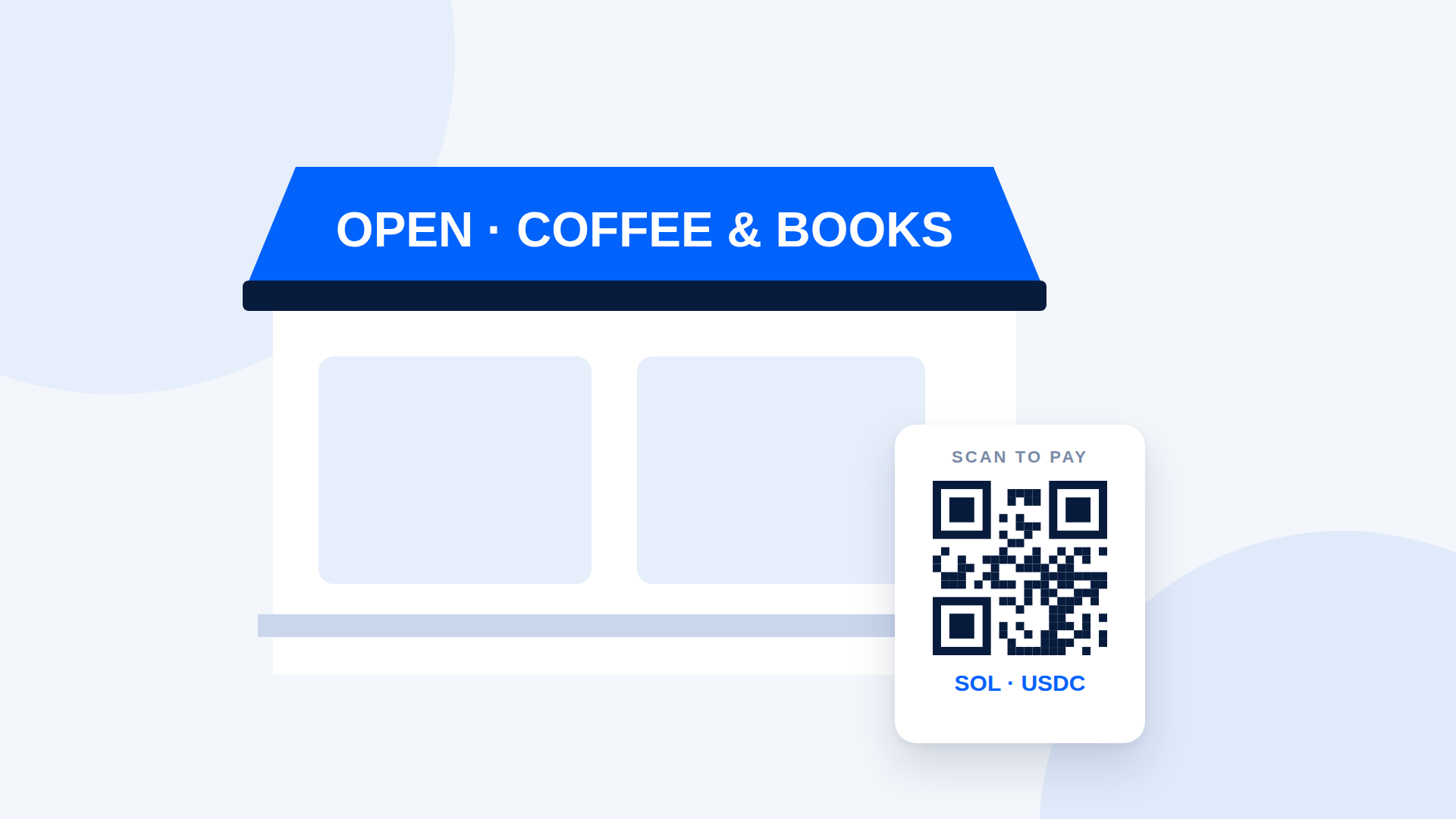
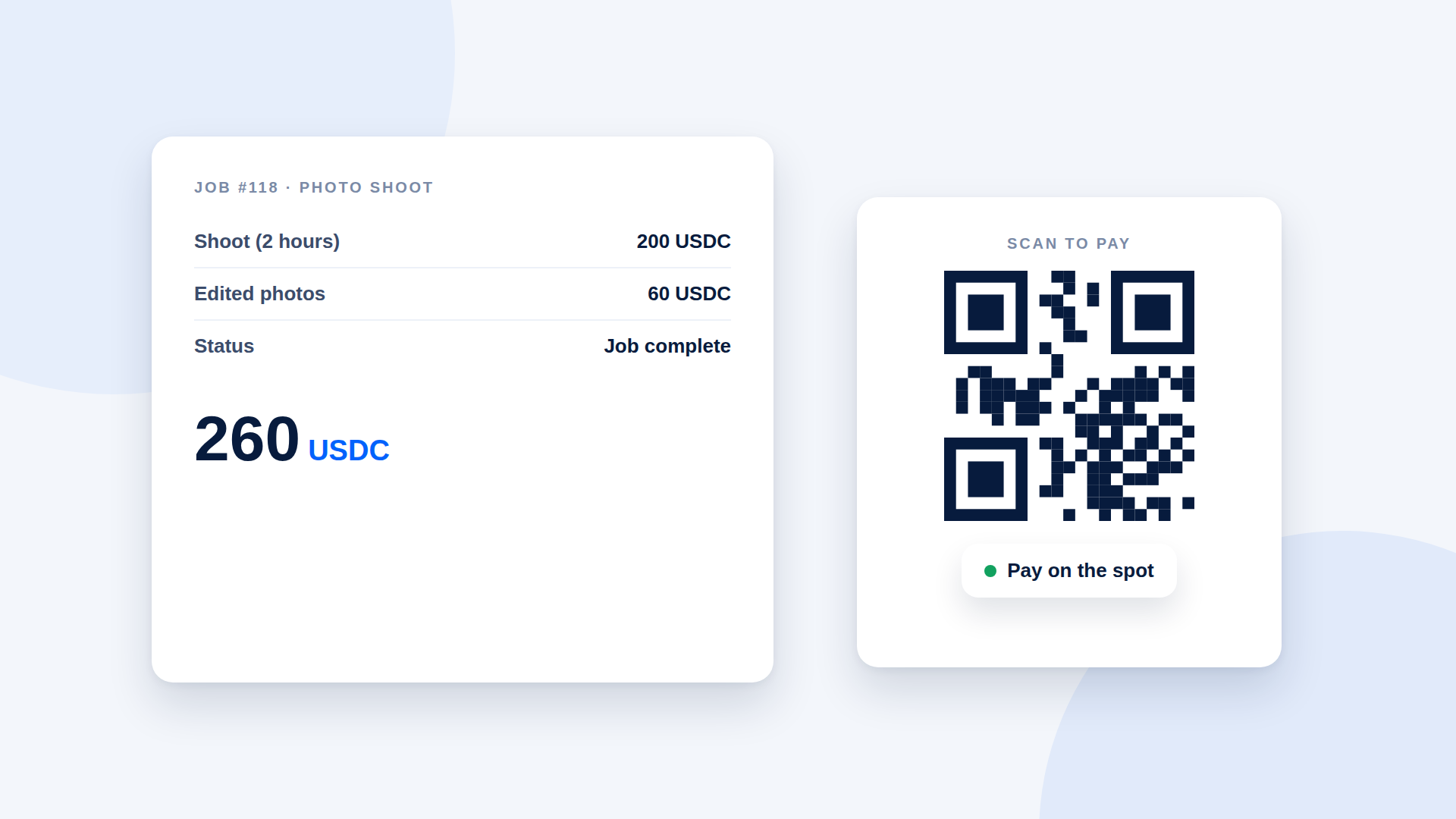
Walk through the checkout yourself as a customer. Count the steps. Check whether the customer needs an account, has to connect a wallet, or can simply scan a QR code. Every extra step costs conversions.
7. What happens if you leave?
Check how easily you can export your payment history, change your wallet and stop using the service. A tool that holds your records hostage is a risk.
A scoring sheet
| Criterion | Your requirement | Provider A | Provider B |
|---|---|---|---|
| Custody | Direct to my wallet | ||
| Verification to start | As little as possible | ||
| Fees at my volume | Lowest total | ||
| Assets and networks | USDC on Solana | ||
| Payment verification | Automatic | ||
| Customer steps | Minimal | ||
| Exit and export | Easy |
Fill it in for two or three options and the choice usually becomes clear.
Red flags
- Vague answers about who holds the money
- Fees that are not clear until after signup
- No way to see how a payment was verified
- Pressure to deposit funds with the provider before you can use it
Where depaylink fits
On this checklist depaylink is non-custodial (customers pay directly to your wallet), says no KYC or KYB is required to start, has 0% transaction fees from depaylink (network fees may apply), supports SOL and USDC on Solana, verifies amount, asset and destination on-chain, and needs no wallet connection or account from the customer. It is a payment-link tool, not a full store checkout.
Frequently asked questions
What is the difference between a crypto gateway and a payment processor?
The terms overlap. Both help you accept payments; check each provider's custody model and features instead of relying on the label.
Do I need KYC to accept crypto payments?
It depends on the provider. Some require verification; others do not. Your own legal obligations apply either way.
What is the cheapest crypto payment gateway?
It depends on your volume and fee structure. Compare real quotes at your numbers.
Should I choose a gateway that supports many coins?
Only if your customers use them. Many merchants do well with one stablecoin on one network.