What Are Crypto Payments and How Do They Work?
A crypto payment is a transfer of digital money, such as a stablecoin or a native coin, from one wallet to another. Instead of a bank or card network approving and settling the payment, a blockchain network records it. The sender signs the transfer, the network verifies it, and the funds appear in the receiver's wallet.
That is the whole idea. The rest of this guide explains each piece in plain terms, so you can tell what is actually happening when a customer pays you, and what you are responsible for.
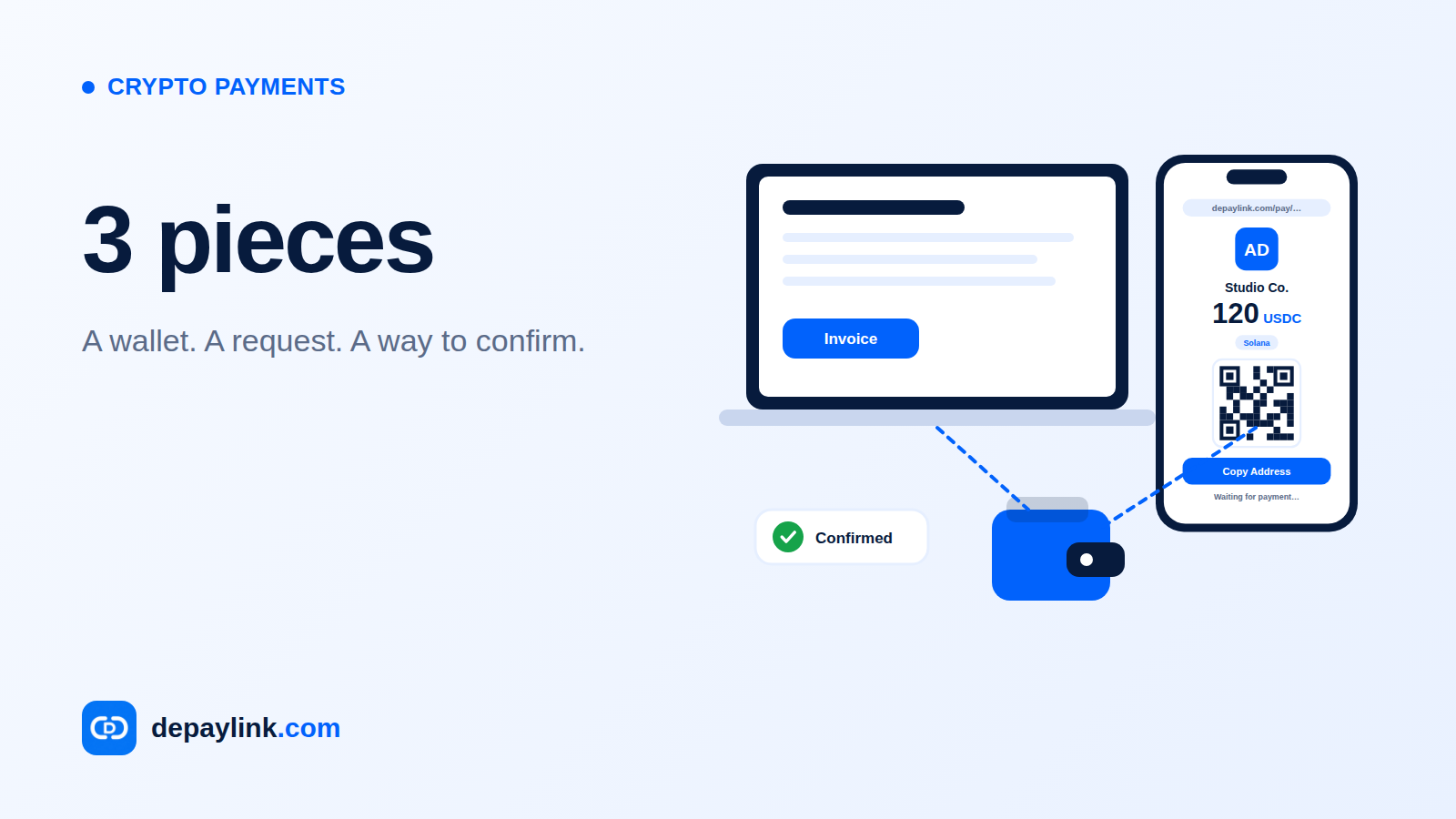
The three things involved in every crypto payment
A wallet on each side
A wallet is software or hardware that holds the keys controlling funds on a blockchain. Each wallet has a public address, which works like an account number that anyone can send to, and a private key, which authorizes spending and must never be shared.
The sender needs a wallet that holds the asset being paid. The receiver needs a wallet address to receive it.
An asset
Crypto payments move specific assets. Two broad types matter for payments:
Native coins, such as SOL on Solana. Their price moves against traditional currencies.
Stablecoins, such as USDC. They are designed to track a currency like the US dollar, so an amount means roughly the same thing from one day to the next.
Requesting a clear asset is part of every good payment request. "100" is ambiguous; "100 USDC" is not.
A network
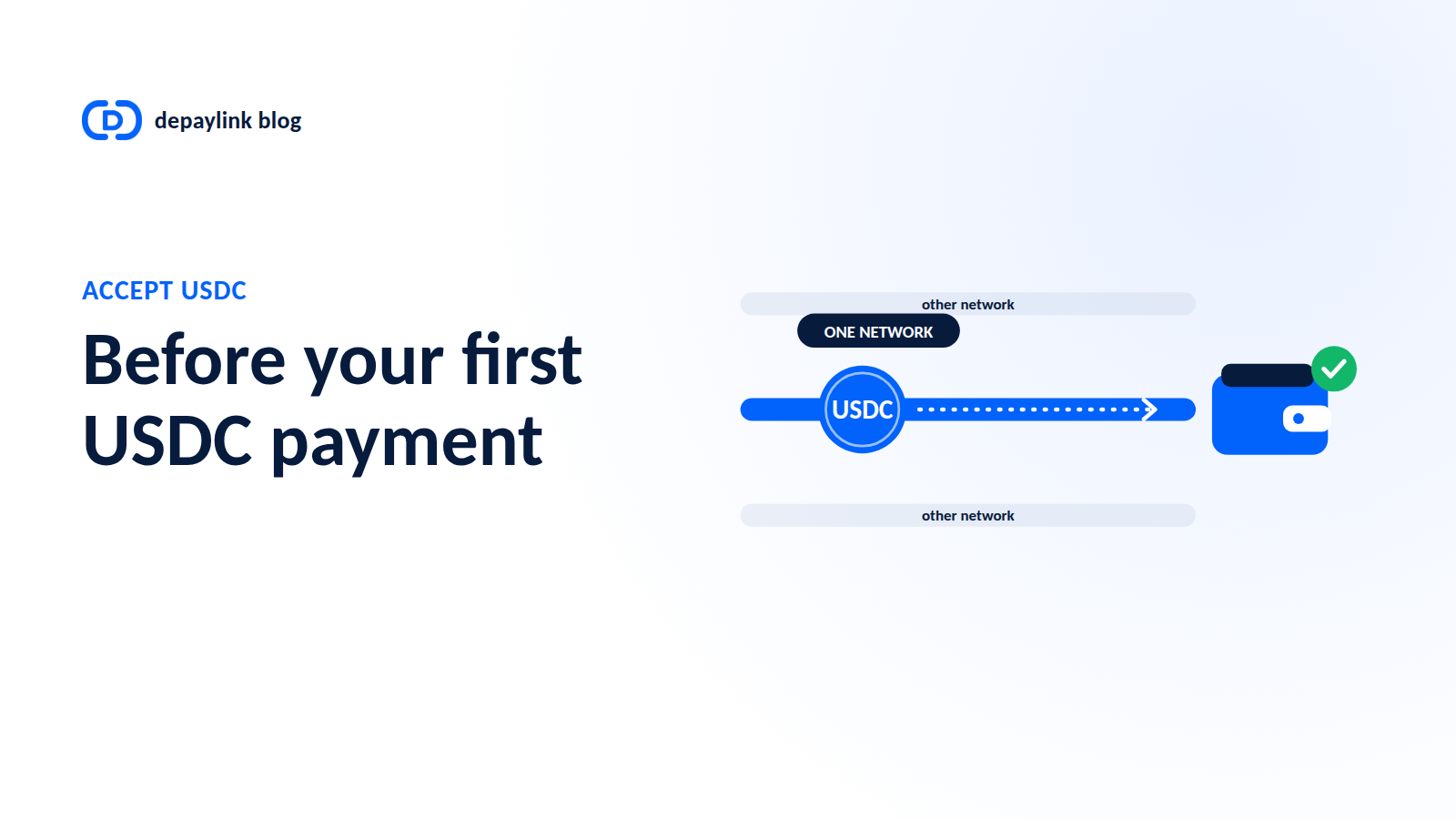
An asset lives on a particular blockchain. The same stablecoin can exist on several networks, and a balance on one network cannot be used on another. The network is where the transfer is recorded and verified. That is why every payment request should name the network.
What happens during a payment, step by step
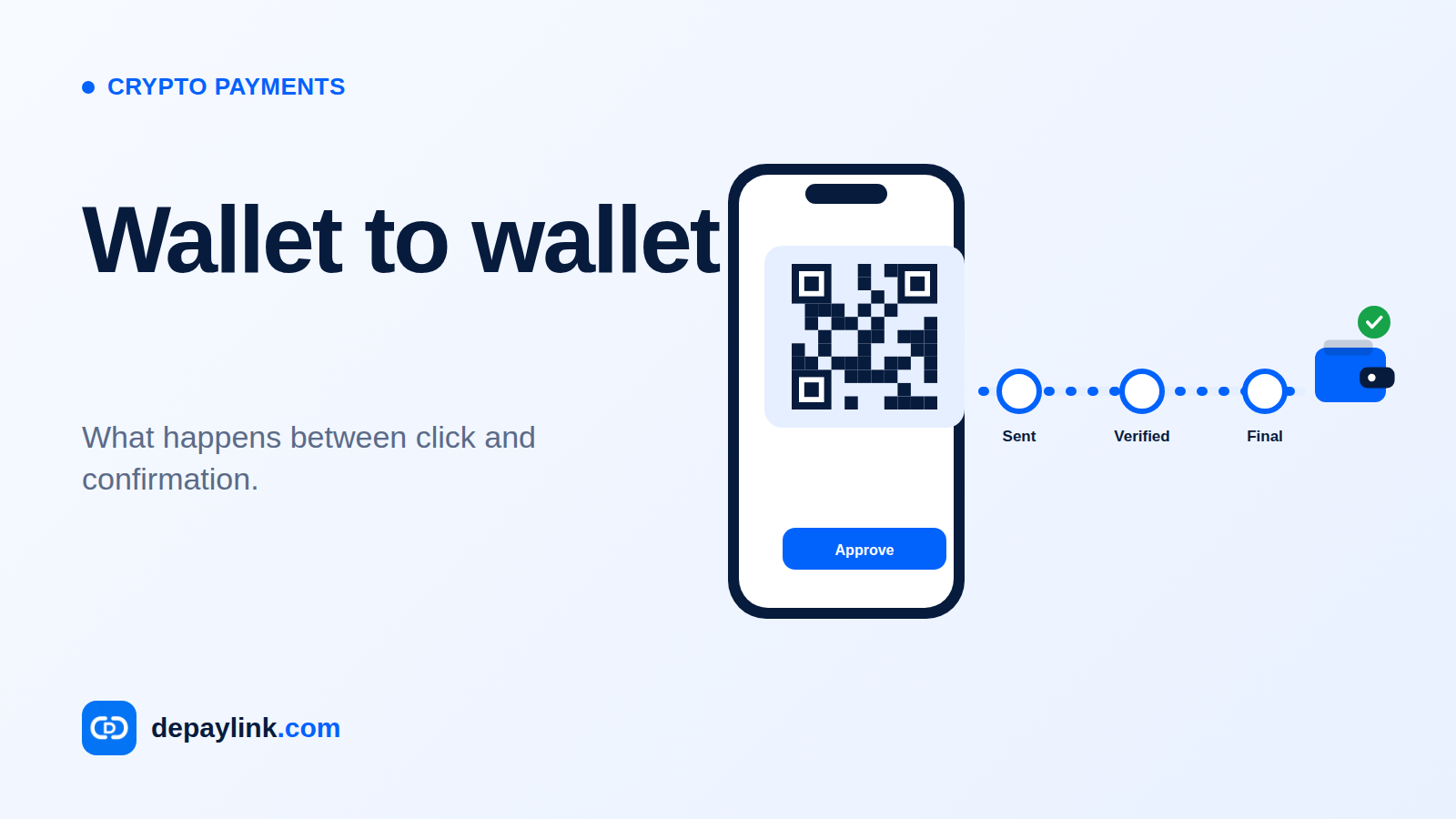
The receiver shares a payment request. It contains an address, an amount, an asset and a network. This can be a plain message, an invoice, a QR code or a payment link.
The payer opens their wallet and enters or scans the request.
The payer reviews and approves. They sign the transfer with their private key. That signature is the authorization.
The transaction is broadcast to the network.
The network verifies it. Participants in the network check that the sender has the funds and that the signature is valid, and they include the transaction in a block.
The transaction reaches finality. After a number of confirmations, depending on the network, it is treated as settled.
The receiver sees the funds in their wallet and can verify the transaction publicly.
The sender pays a small network fee for the transfer. On most networks the fee is paid in the network's native coin, even when the payment itself is a different asset. For example, on Solana, sending USDC still requires a little SOL.
How crypto payments differ from card and bank payments
Card payment | Bank transfer | Crypto payment | |
|---|---|---|---|
Who approves | Card network and issuing bank | Banks involved in the route | The blockchain network, via the sender's signature |
Intermediaries | Several | One or more banks | None between the two wallets |
Reversible by sender | Often, through chargebacks | Sometimes | No |
Works outside banking hours | Yes | Often limited | Yes |
Requires | A card | A bank account | A wallet and the right asset |
Proof of payment | Statement | Statement | Public transaction on the network |
None of these is better in every case. They fit different customers and different risk tolerances.
What "finality" means and why it matters
Once a crypto transaction is final, nobody can undo it, including the sender, the receiver and the network. That is a major feature for sellers because there are no card-style chargebacks. It is also why mistakes are costly: a payment sent to the wrong address or on the wrong network cannot be recalled.
For a seller, this changes the habit. You verify the payment yourself and you decide what to do about refunds. A refund is a new payment you send, not a reversal.
Why many businesses use stablecoins for payments
A stablecoin keeps the invoice amount predictable. If you quote 250 USDC and receive 250 USDC, the number matches. With a volatile asset you must either accept the price risk or convert at a defined rate at the time of payment.
Stablecoins carry their own risks: the issuer's reserves, redemption, regulation and the possibility of trading slightly away from the target value. Read the issuer's current disclosures, and do not hold more than you are comfortable with.
What you need as a merchant
A wallet you control, with its recovery phrase backed up offline.
A clear payment request each time: amount, asset, network and what it is for.
A way to confirm payments: your wallet, a block explorer or a dashboard.
A refund and error policy, because transfers are not reversible.
A records habit: date, amount, asset, local-currency value and the transaction reference.
Where a payment link fits
You can send a wallet address in a message, but a payment link is easier for everyone. It opens a page that shows the amount, asset and address together, often with a QR code, and it can show whether payment has arrived.
depaylink works this way on Solana. You enter what you are charging for, the amount, SOL or USDC, and your receiving wallet. The customer opens a payment page with the details and a QR code, pays from their own wallet, and your dashboard shows each link as pending or paid. The funds go to the wallet you specified, so you stay in control of your keys.
Risks and limits to be honest about
Irreversibility. A wrong address or wrong network means lost funds.
Scams. Fake screenshots, lookalike tokens and urgent requests exist. Verify on the network, not from a screenshot.
Customer readiness. Your customer needs a wallet, the asset and, usually, a little of the network's native coin for fees.
Conversion. If you want local currency, you need an exchange or off-ramp.
Rules. Tax and regulatory treatment varies by country. This is general information, not tax or legal advice; ask a local professional.
Who crypto payments suit
Freelancers and agencies with international clients.
Creators and online sellers who work through social media and messaging apps.
Businesses in or near the crypto and Web3 world.
Anyone who wants payments that work outside banking hours and can be verified publicly.
They are less suited to customers who have no wallet and no interest in getting one. In that case, offer crypto as an extra option, not the only one.
A simple way to start
Create a wallet you control and back up the recovery phrase offline.
Choose one asset and one network.
Create a payment link for your next invoice.
Send yourself a small test payment first.
Verify the payment before you deliver.
FAQ
Do crypto payments need a bank? No bank sits between the two wallets. If you want to convert to local currency, you will use an exchange or other off-ramp that connects to a bank.
Are crypto payments anonymous? No. Transactions are public on the blockchain, tied to wallet addresses. Whether an address is linked to your identity depends on how you use it.
Can a crypto payment be cancelled? Not once it is final. A refund is a new payment from the receiver.
How long does a crypto payment take? It depends on the network. Some confirm within seconds. Wait for the level of confirmation that matches the risk of what you are delivering.
Do I need to understand blockchains to accept crypto? No. You need a wallet, a clear payment request and a way to verify receipt. A payment link tool handles the rest of the presentation.
Crypto Payment Scams: How to Avoid Fake Payments and Fake Confirmations