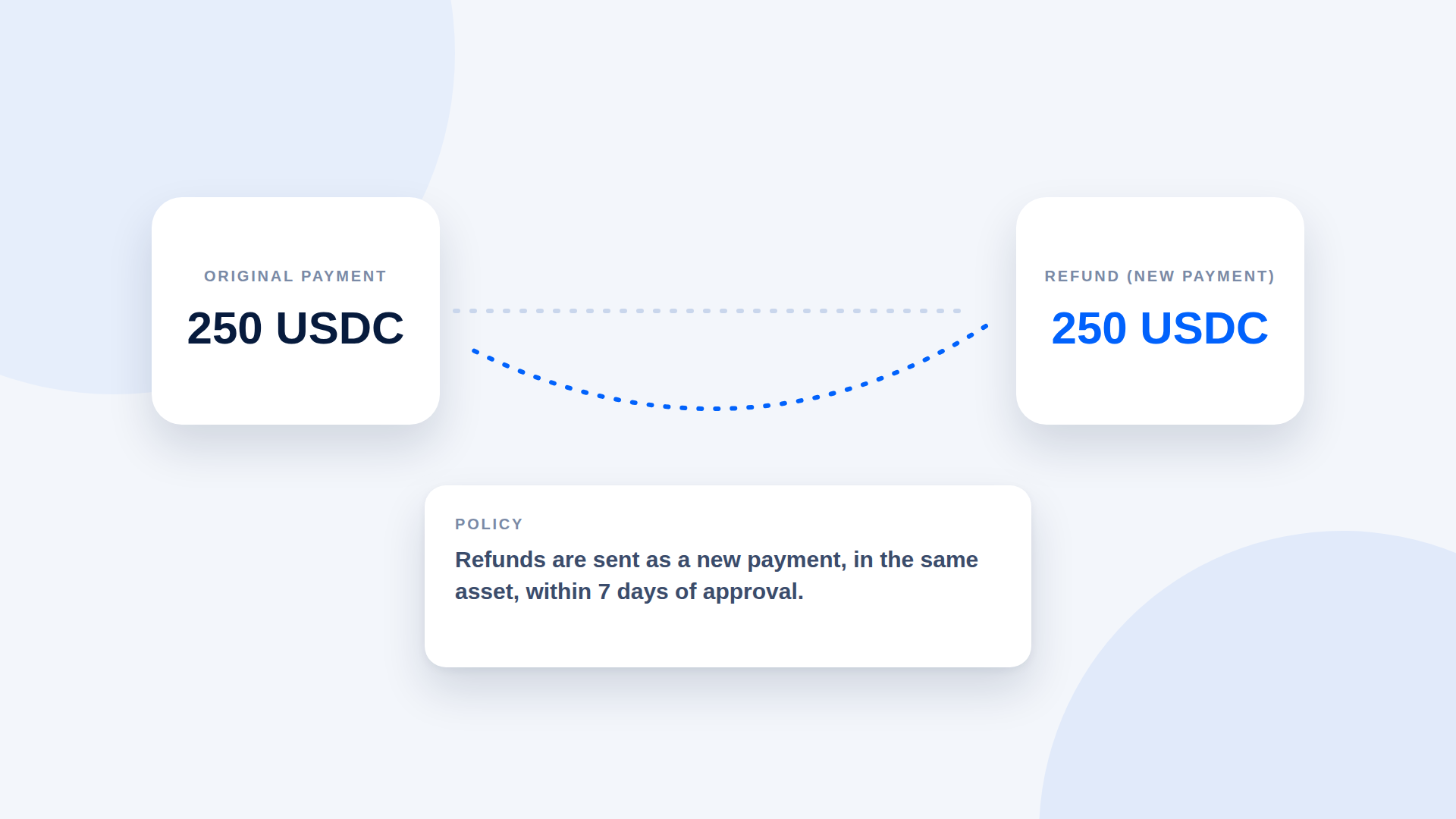
A crypto payment cannot be reversed by a card network or a processor. If you owe a customer money back, you send a new payment. That makes your refund policy the thing that protects both sides, so write it before you take the first payment and show it where customers will see it.
How refunds work in crypto
- The customer pays you, and the transfer is recorded on the blockchain.
- You and the customer agree a refund is due.
- You send a new transfer from your wallet to theirs.
- You record it against the original payment.
There is no chargeback system in the middle, and no one else can pull the money back for the customer.
Decisions your policy should make
| Question | Options |
|---|---|
| Which payments are refundable? | All, some products or services, or none |
| Time window | For example 7 or 14 days |
| Refund asset | The same asset, or another by agreement |
| Amount | Full, partial or minus costs |
| Who pays the network fee? | You, the customer or deducted |
| Where does it go? | The wallet the payment came from, confirmed with the customer |
| How is a request made? | An email or message with the order reference |
Pitfalls specific to crypto
- Exchange wallets: if the customer paid from an exchange, the sending address may not be theirs to receive funds. Ask for a wallet address they control.
- Wrong network: a refund on the wrong network can be lost.
- Price changes: if the customer paid in SOL, decide whether you refund the same amount of SOL or the original value.
- Fake refund requests: confirm the requester is the real customer before sending.
A simple template
Refund policy Payments are made in USDC on Solana. Because crypto transfers cannot be reversed by a processor, refunds are issued as a new payment. You can request a refund within [7] days of payment by contacting [email] with your order reference. Approved refunds are sent in USDC to a Solana wallet address you confirm, within [7] days of approval. Network fees are [covered by us / deducted]. [Digital goods / services that are non-refundable once delivered.]
Adapt it to your products and your local consumer rules.
Local rules
Consumer protection rules differ by country and may give customers rights you cannot waive, whatever payment method they use. Check what applies to you, and ask a local professional if you are unsure.
Keep records
Note the original payment reference, the refund transaction ID, the date and the reason. Your accountant will want it.
Reduce refunds before they happen
- Describe the product or service clearly.
- Name the asset and network on every request.
- Verify payments before delivering.
- Answer questions before the customer pays.
Where depaylink fits
depaylink verifies payments on Solana and marks them as paid, and funds go straight to your wallet, so you control any refund. It does not process refunds or offer dispute resolution. Send refunds from your wallet and note them against the original link. Payment history on every plan helps you find the original payment.
Frequently asked questions
Can crypto payments be charged back?
Not through a card-style chargeback. Refunds are a separate payment you send.
Should I refund in the same asset?
Usually, and state it in your policy.
Who pays the network fee on a refund?
Decide in your policy: you, the customer or deducted from the refund.
Do consumer protection laws apply to crypto sales?
They may. Check local rules.
Related reading
- How Crypto Payments Work: From Customer Wallet to Your Wallet
- How to Accept Crypto Payments for Local Services (Photographers, Tutors, Repairs)
- Payment verification
- How to Verify a Crypto Payment Before You Deliver
- How to Accept Crypto Payments as a Coach or Consultant
- How to Sell Digital Products and Get Paid in Crypto
- Crypto Payment Bookkeeping for Small Businesses: What to Record