USDC Payments Explained: How to Send, Receive and Verify USDC
USDC is a stablecoin designed to be worth one US dollar per token. People use it for payments because an amount keeps its meaning: 250 USDC today is meant to be 250 USDC next week, and it can be sent to anyone with a compatible wallet, at any hour, without waiting on a bank.
This guide covers the three things you do with USDC as a business: receive it, verify it and keep sensible records. It also covers what can go wrong.
What USDC is
USDC is issued by Circle. The issuer states that USDC is backed by reserves and redeemable for US dollars. Those are the issuer's statements, so check its current disclosures rather than relying on any summary, including this one.
Two points matter for payments:
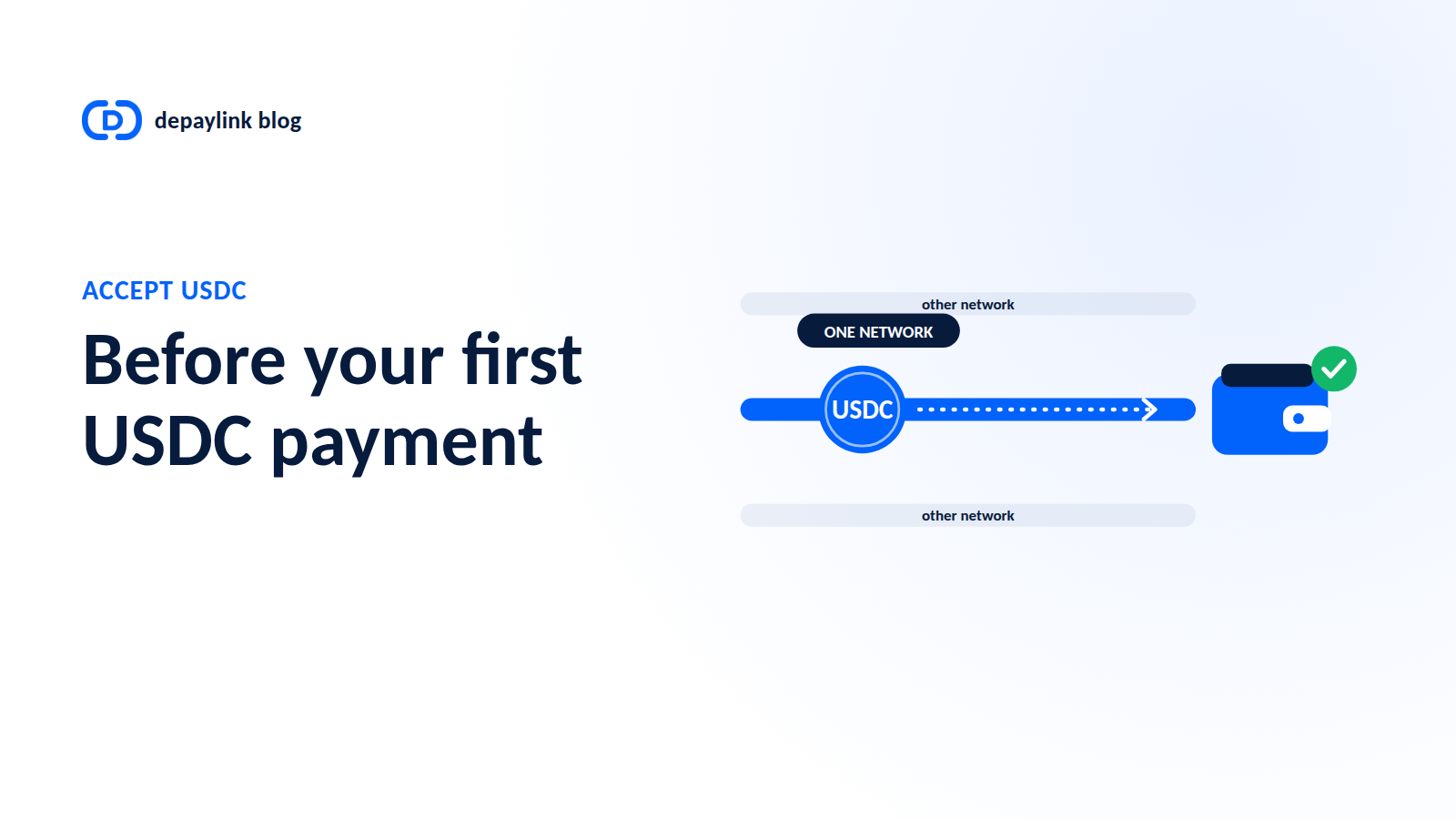
USDC is a token on a blockchain. It exists on several networks, and a balance on one network cannot be spent on another.
It is not a bank deposit. It does not carry bank deposit protection, and it moves under blockchain rules, not banking rules.
Why businesses choose USDC
Predictable invoices. The amount you quote is the amount you receive.
Cross-border reach. A client in another country does not need a bank route to you.
Outside banking hours. A transfer can happen on a weekend.
Public verification. Anyone can inspect a transaction on the network.
It is not the right choice for every client. If a client's finance team can only pay by bank transfer, offer that.
How a USDC payment moves
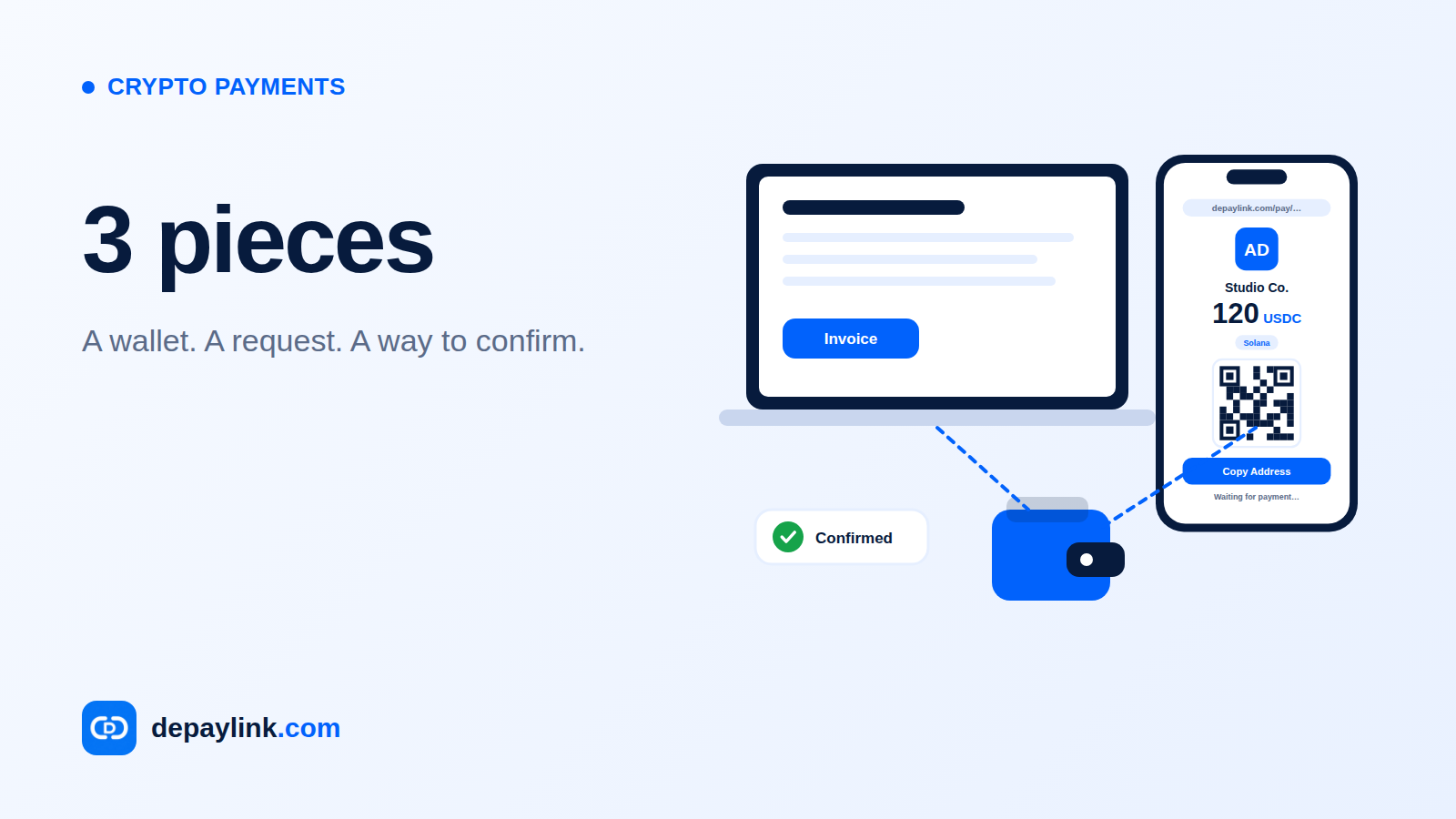
You publish a request with your address, amount (in USDC), network and a reference.
The payer opens their wallet, which must hold USDC on that same network.
The payer signs the transfer and pays a small network fee, usually in the network's native coin.
The network records and confirms the transaction.
The USDC arrives in your wallet.
On Solana, for example, a payer needs USDC on Solana and a little SOL for the fee. Telling clients this up front prevents most first-payment problems.
Receiving USDC: what to set up
A wallet you control
Create a wallet, write the recovery phrase on paper, store it offline, and never share it with anyone. Use a dedicated wallet for business so records stay clean.
A clear payment request
Every request should include:
the amount, written as USDC, not "dollars",
the network, spelled out,
the receiving address, ideally also as a QR code,
a reference, such as an invoice number,
what happens if the amount is wrong.
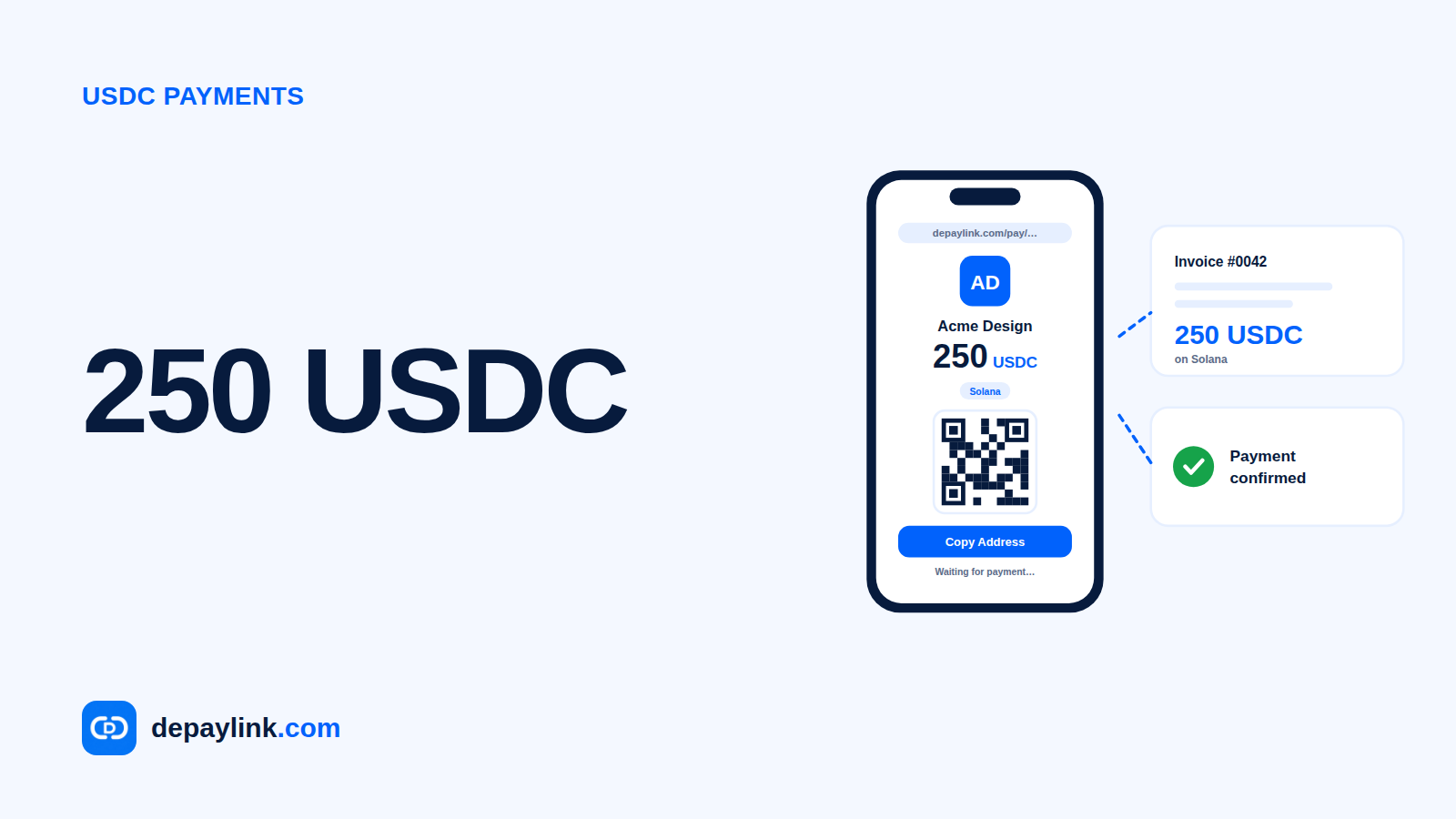
A payment link bundles these on one page so the payer sees everything at once. With depaylink, you enter what you are charging for, the amount, USDC or SOL, and your receiving wallet. The payer gets a page with the amount, a Solana label, a QR code and the address.
Verifying a USDC payment
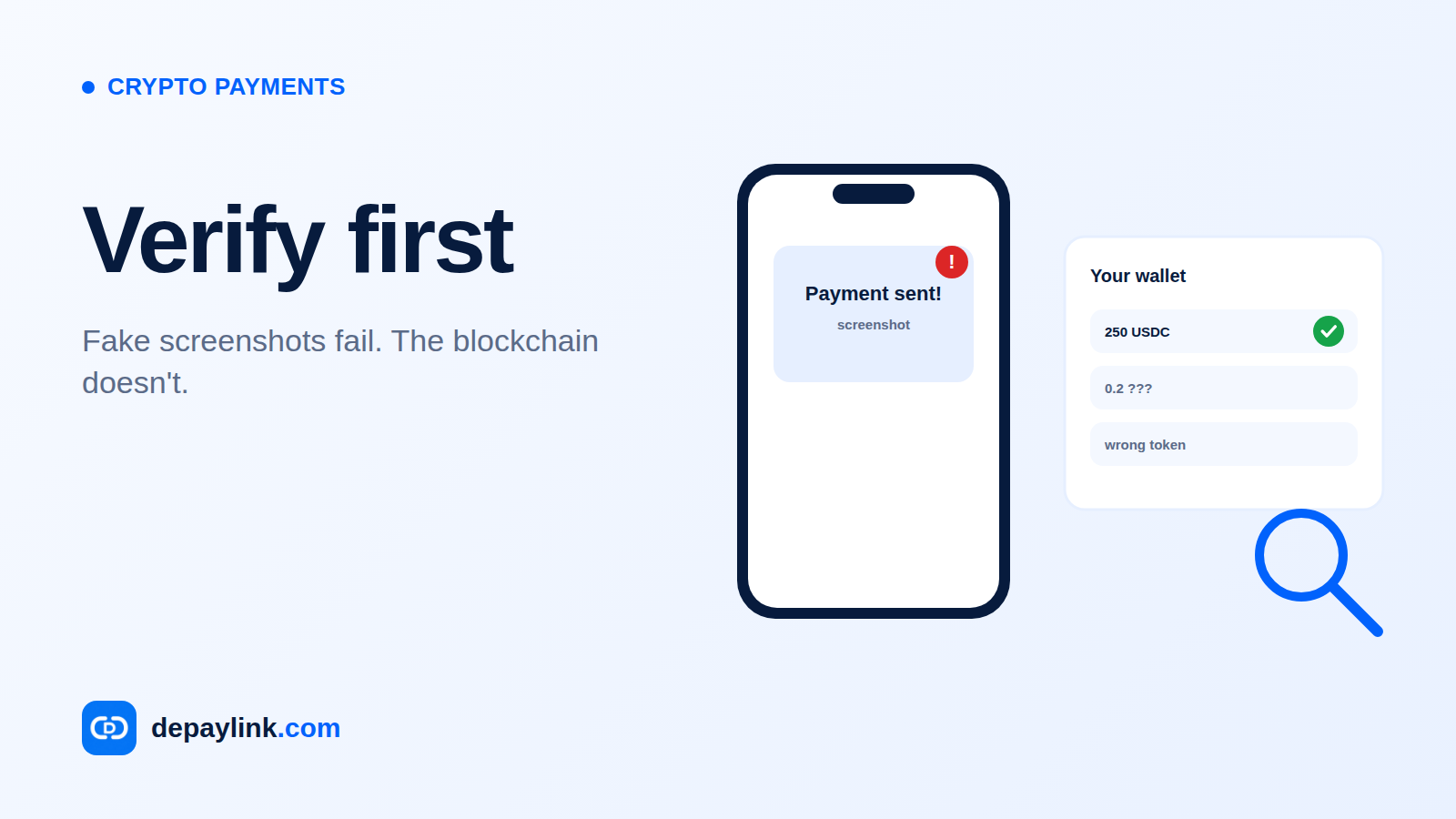
Never treat "I've sent it" or a screenshot as proof. Check:
The token. It is the real USDC, not a lookalike with the same name. Compare its identifier with the one the issuer publishes.
The amount. It matches the request.
The recipient. It is your address.
The network stage. The transaction is confirmed or final, depending on the value at stake.
The order. It matches one specific invoice or link.
For occasional payments, a block explorer is enough. For regular payments, use a tool that tracks each request and shows it as pending or paid, then still apply your own rule before delivering.
Risks to understand
Risk | What it means | What to do |
|---|---|---|
Peg risk | USDC can trade slightly below one dollar in stress events | Do not hold more than you need |
Issuer and reserve risk | You rely on the issuer's reserves and redemptions | Read the issuer's current disclosures |
Operational risk | Wrong network, wrong address, lookalike token | Test payments, check addresses, verify the token |
Regulatory risk | Rules differ by country and change | Ask a local professional |
Platform risk | Exchanges and wallets have their own terms | Choose reputable providers; do not leave large balances idle |
Records for USDC payments
Log each payment as it arrives: date and time, client and invoice, amount in USDC, the local-currency value at receipt, and the transaction reference. Tax treatment varies by country. This is general information, not tax advice; ask a local accountant.
Turning USDC into local currency
USDC does not turn into local currency by itself. You send it to an exchange or other off-ramp that supports your region and the network you hold it on, sell it and withdraw to your bank. Compare total cost, including fees and spreads, and send a small test first.
A short checklist
Wallet created, recovery phrase stored offline.
Network chosen and stated on every invoice.
Payment link or QR code created for each invoice.
Small test payment completed.
A rule for verifying payments before delivery.
A plan for converting to local currency.
FAQ
What does USDC stand for? It is the name of the token, commonly read as "USD Coin."
Is USDC always worth exactly one dollar? It is designed to be, and has generally stayed close, but no stablecoin is guaranteed to hold its value.
Can I receive USDC without a business? Technically yes, with any compatible wallet. Reporting obligations depend on where you live.
Do I need SOL to receive USDC on Solana? Normally the sender pays the fee. Mainstream wallets also handle token accounts automatically. Send a small test with any unusual wallet.
What if someone sends USDC on the wrong network? Recovery is not guaranteed, which is why the network belongs on every invoice.
What Are Crypto Payments and How Do They Work?Crypto Payment Scams: How to Avoid Fake Payments and Fake ConfirmationsHow to Accept Crypto Payments for Your BusinessHow to Record USDC Payments for Your Accountant (or in QuickBooks)USDC on Solana vs Other Networks: How to Avoid Wrong-Network MistakesHow Solana Payments Work: What Happens When a Customer PaysHow to Accept USDC Payments: What to Check Before Your First OneHow to Accept Crypto Payments for Your BusinessHow to Accept SOL Payments From Customers